Gateway Software Symposium
May 13 - 15, 2011 - St. Louis, MO
Pratik Patel
CTO TripLingo & Code Hacker
Pratik Patel is the CTO of Atlanta based TripLingo (http://www.triplingo.com/). He wrote the first book on 'enterprise Java' in 1996, "Java Database Programming with JDBC." He has also spoken at various conferences and participates in several local tech groups and startup groups. He's in the startup world now and hacks iOS, Android, HTML5, CSS3, JavaScript, Rails, and ..... well everything except Perl.
Pratik's specialty is in large-scale applications for mission-critical and mobile applications use. He has designed and built applications in the retail, health care, financial services, and telecoms sectors. Pratik holds a master's in Biomedical Engineering from UNC, has worked in places such as New York, London, and Hong Kong, and currently lives in Atlanta, GA.
Presentations
Intro to Clustering with Terracotta
Terracotta is an open-source cluster framework. In this session, attendees will begin by learning about Terracotta architecture and setup. We'll then examine the Terracotta Toolkit in detail with live code examples. Attendees will learn about features in the Terracotta toolkit: barriers, locking, clustered collections, and more. We'll discuss the usage of these features and how to best utilize them across a cluster of JVM's / app servers. We'll also talk about how to setup for high-availability.
Topics in this session: * Understanding clustering * Understanding Terracotta and how it clusters * Terracotta shared objects will be discussed briefly to set the stage for the underpinnings of the Terracotta toolkit * Setting up Terracotta configuration * Code demos that are available to all attendees on Github
From Zero-to-Hero with EHCache
Ehcache is the most popular open source cache framework for the JVM. It is integrated into many open-source packages, such as Grails. First, we'll cover the concept of caching objects and use cases around caching. In this session, we'll get into Ehcache details about architecture, configuration, design, cache types and more. Attendees will learn how to configure Ehcache and we'll discuss the major configuration options. We'll also do some live code demos so attendees can better understand the concepts and features of caching and Ehcache. Of course, we'll also see how it plugs into ORM / JPA tools like Hibernate.
Topics: * Understanding Caching * When to use caching * Setting up EHCache * Setting up Ehcache with Terracotta plumbing * Setting up Ehcache with other plumbing * Code demos * Tips for optimizing the cache size and usage * Integration of the cache with Hibernate * Hibernate example code
Enterprise Integration with Apache Camel and Spring Integration
Enterprise Integration used to be mundane and tedious - developers had to build all the code by hand and testing was difficult. With the rise of popular Enterprise Integration toolkits such as Apache Camel, this is no longer the case. Apache Camel makes it a breeze to do enterprise integration, and in this session, you'll be introduced to both Enterprise Integration basics as well as implementing them with Apache Camel.
Along with Apache Camel, we'll also look at Spring Integration. Filled with lots of code examples from both Camel and SI, we'll see how you implement common Enterprise Integration patterns. We'll compare and contrast the two approaches and get you up-to-speed so you can start using these tools quickly.
Easy Mobile Development Workshop: Mobile GUI Frameworks
Bring your laptop! This is a workshop specifically designed to get you up and running with popular mobile GUI frameworks and build feature-rich application in 90 minutes! Install a good Javascript/HTML editor, Google Chrome, and Safari (or another newer Webkit based web browser) and the latest PhoneGap release. Also install the latest Android SDK. MAKE SURE YOU HAVE DONE THIS BEFORE COMING TO THE WORKSHOP. Of course, you're welcome to come watch as we work through the exercises, or pair up with a new friend. You can also install the latest iOS SDK if you have a Mac and are interested in iPhone/iPad development.
There are a number of great Javascript frameworks for creating slick-looking Mobile Web GUI's. In this session, we'll look at some of the popular ones while building a mobile GUI. We'll have a look at JQTouch, Jo, and jQuery Mobile.
This is a 90 minute workshop intended to teach you the basics of working with these mobile GUI frameworks. We'll work on several exercises as you build up a complete, feature-rich, mobile application that you can test on either Android or iOS devices. Topics we'll cover in this workshop: * Webkit web browser * webkit extensions * jQTouch ** Navigation ** UI widgets * Jo ** Navigation ** UI widgets * jQuery Mobile ** Navigation ** UI widgets * Creating a native app using PhoneGap ** PhoneGap overview ** Bundling your HTML/CCS/javascript in PhoneGap ** Building with PhoneGap
Books
by Pratik Patel and Karl Moss
-
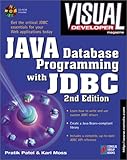
Java Database Programming with JDBC by Pratik Patel and Karl Moss is an updated edition of the authors' guide to the Java Database Connectivity (JDBC) standard for database programming under Java. While the original edition was perhaps geared more to those developers who needed to write their own JDBC database drivers, a fairly arduous task, this new edition provides more background information on database connectivity issues in Java and so will be even more useful to the casual or intermediate programmer. After a general introduction to JDBC and Structured Query Language (SQL), useful even to beginning programmers, the authors start by building a simple database-aware applet. New chapters on "servlets," Java components that run on the server-side and manage database operations, as well as a general discussion of middleware technologies are particularly good. Database access for JavaBean components (from Sun Microsystems JDK 1.1) is also discussed, including working code for two database-aware beans. This book also includes a quick introduction to the Java language (which will only be helpful if you already know C/C++), a detailed reference for the JDBC API, and a working example of a text-based JDBC driver. Though this book is still oriented toward the JDBC driver developer, the authors now provide enough general discussion of JDBC architectural issues to make it worthwhile to any programmer who needs to ramp up on what JDBC is and what capabilities it offers.
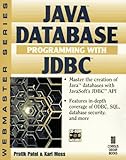
- Java Database Programming with JDBC by Pratik Patel and Karl Moss is an updated edition of the authors' guide to the Java Database Connectivity (JDBC) standard for database programming under Java. While the original edition was perhaps geared more to those developers who needed to write their own JDBC database drivers, a fairly arduous task, this new edition provides more background information on database connectivity issues in Java and so will be even more useful to the casual or intermediate programmer. After a general introduction to JDBC and Structured Query Language (SQL), useful even to beginning programmers, the authors start by building a simple database-aware applet. New chapters on "servlets," Java components that run on the server-side and manage database operations, as well as a general discussion of middleware technologies are particularly good. Database access for JavaBean components (from Sun Microsystems JDK 1.1) is also discussed, including working code for two database-aware beans. This book also includes a quick introduction to the Java language (which will only be helpful if you already know C/C++), a detailed reference for the JDBC API, and a working example of a text-based JDBC driver. Though this book is still oriented toward the JDBC driver developer, the authors now provide enough general discussion of JDBC architectural issues to make it worthwhile to any programmer who needs to ramp up on what JDBC is and what capabilities it offers.
by Pratik Patel and Karl Moss
-
Java Database Programming with JDBC by Pratik Patel and Karl Moss is an updated edition of the authors' guide to the Java Database Connectivity (JDBC) standard for database programming under Java. While the original edition was perhaps geared more to those developers who needed to write their own JDBC database drivers, a fairly arduous task, this new edition provides more background information on database connectivity issues in Java and so will be even more useful to the casual or intermediate programmer. After a general introduction to JDBC and Structured Query Language (SQL), useful even to beginning programmers, the authors start by building a simple database-aware applet. New chapters on "servlets," Java components that run on the server-side and manage database operations, as well as a general discussion of middleware technologies are particularly good. Database access for JavaBean components (from Sun Microsystems JDK 1.1) is also discussed, including working code for two database-aware beans. This book also includes a quick introduction to the Java language (which will only be helpful if you already know C/C++), a detailed reference for the JDBC API, and a working example of a text-based JDBC driver. Though this book is still oriented toward the JDBC driver developer, the authors now provide enough general discussion of JDBC architectural issues to make it worthwhile to any programmer who needs to ramp up on what JDBC is and what capabilities it offers.
- Java Database Programming with JDBC by Pratik Patel and Karl Moss is an updated edition of the authors' guide to the Java Database Connectivity (JDBC) standard for database programming under Java. While the original edition was perhaps geared more to those developers who needed to write their own JDBC database drivers, a fairly arduous task, this new edition provides more background information on database connectivity issues in Java and so will be even more useful to the casual or intermediate programmer. After a general introduction to JDBC and Structured Query Language (SQL), useful even to beginning programmers, the authors start by building a simple database-aware applet. New chapters on "servlets," Java components that run on the server-side and manage database operations, as well as a general discussion of middleware technologies are particularly good. Database access for JavaBean components (from Sun Microsystems JDK 1.1) is also discussed, including working code for two database-aware beans. This book also includes a quick introduction to the Java language (which will only be helpful if you already know C/C++), a detailed reference for the JDBC API, and a working example of a text-based JDBC driver. Though this book is still oriented toward the JDBC driver developer, the authors now provide enough general discussion of JDBC architectural issues to make it worthwhile to any programmer who needs to ramp up on what JDBC is and what capabilities it offers.
by Pratik R. Patel, Alan D. Hudson, and Donald A. Ball
-
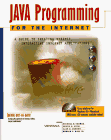
Enables readers to master the Java programming language for internet applications while expanding the scope of online development, and the accompanying CD contains powerful sample applets and a copy of Netscape Navigator. Original. (Intermediate).
- Enables readers to master the Java programming language for internet applications while expanding the scope of online development, and the accompanying CD contains powerful sample applets and a copy of Netscape Navigator. Original. (Intermediate).