
Kenneth Kousen
President, Kousen IT, Inc.

Ken Kousen is a Java Champion, several time JavaOne Rock Star, and a Grails Rock Star. He is the author of the Pragmatic Library books “Mockito Made Clear” and “Help Your Boss Help You,” the O'Reilly books “Kotlin Cookbook”, “Modern Java Recipes”, and “Gradle Recipes for Android”, and the Manning book “Making Java Groovy”. He also has recorded over a dozen video courses for the O'Reilly Learning Platform, covering topics related to Android, Spring, Java, Groovy, Grails, and Gradle.
His academic background include BS degrees in Mechanical Engineering and Mathematics from M.I.T., an MA and Ph.D. in Aerospace Engineering from Princeton, and an MS in Computer Science from R.P.I. He is currently President of Kousen IT, Inc., based in Connecticut.
PRESENTATIONS
BOOKS
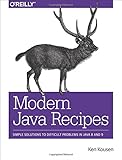
Modern Java Recipes: Simple Solutions to Difficult Problems in Java 8 and 9
The introduction of functional programming concepts in Java SE 8 was a drastic change for this venerable object-oriented language. Lambda expressions, method references, and streams fundamentally changed the idioms of the language, and many developers have been trying to catch up ever since. This cookbook will help. With more than 70 detailed recipes, author Ken Kousen shows you how to use the newest features of Java to solve a wide range of problems.
For developers comfortable with previous Java versions, this guide covers nearly all of Java SE 8, and includes a chapter focused on changes coming in Java 9. Need to understand how functional idioms will change the way you write code? This cookbook—chock full of use cases—is for you.
Recipes cover:
- The basics of lambda expressions and method references
- Interfaces in the java.util.function package
- Stream operations for transforming and filtering data
- Comparators and Collectors for sorting and converting streaming data
- Combining lambdas, method references, and streams
- Creating instances and extract values from Java’s Optional type
- New I/O capabilities that support functional streams
- The Date-Time API that replaces the legacy Date and Calendar classes
- Mechanisms for experimenting with concurrency and parallelism
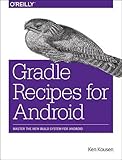
Gradle Recipes for Android
Using the Android Studio IDE and the Gradle build tool will make Android app development much simpler—as long as you know your way around Gradle. This practical guide shows you how Gradle works with Android so that you can use it effectively on your projects. You’ll learn ways to customize project layouts, add dependencies, and even generate multiple different versions of your application.
- Use Gradle independently and from with the new preferred IDE, Android Studio
- Integrate tests into standard Android project builds
- Easily customize builds to add popular third-party libraries as dependencies
- Generate artifacts with various properties, like debug or release, and different flavors, like paid or free

Making Java Groovy
Summary
Making Java Groovy is a practical handbook for developers who want to blend Groovy into their day-to-day work with Java. It starts by introducing the key differences between Java and Groovy—and how you can use them to your advantage. Then, it guides you step-by-step through realistic development challenges, from web applications to web services to desktop applications, and shows how Groovy makes them easier to put into production.
About this Book
You don't need the full force of Java when you're writing a build script, a simple system utility, or a lightweight web app—but that's where Groovy shines brightest. This elegant JVM-based dynamic language extends and simplifies Java so you can concentrate on the task at hand instead of managing minute details and unnecessary complexity.
Making Java Groov is a practical guide for developers who want to benefit from Groovy in their work with Java. It starts by introducing the key differences between Java and Groovy and how to use them to your advantage. Then, you'll focus on the situations you face every day, like consuming and creating RESTful web services, working with databases, and using the Spring framework. You'll also explore the great Groovy tools for build processes, testing, and deployment and learn how to write Groovy-based domain-specific languages that simplify Java development.
Written for developers familiar with Java. No Groovy experience required.
Purchase of the print book includes a free eBook in PDF, Kindle, and ePub formats from Manning Publications.
What's Inside
- Easier Java
- Closures, builders, and metaprogramming
- Gradle for builds, Spock for testing
- Groovy frameworks like Grails and Griffon
About the Author
Ken Kousen is an independent consultant and trainer specializing in Spring, Hibernate, Groovy, and Grails.
Table of Contents
- Why add Groovy to Java?
- Groovy by example
- Code-level integration
- Using Groovy features in Java
- Build processes
- Testing Groovy and Java projects
- The Spring framework
- Database access
- RESTful web services
- Building and testing web applications
PART 1: UP TO SPEED WITH GROOVY
PART 2: GROOVY TOOLS
PART 3: GROOVY IN THE REAL WORLD
![Groovy Fundamentals [Online Code]](http://ecx.images-amazon.com/images/I/41DcWJuNVSL._SL160_.jpg)
Groovy Fundamentals [Online Code]
Author: Ken Kousen
User Level: Beginner
Learn the advantages of using Groovy by itself and with existing Java projects. This video workshop takes you into the heart of this JVM language and shows you how Groovy can help increase your productivity through dynamic language features similar to those of Python, Ruby, and Smalltalk. Presenter and Java consultant Ken Kousen demonstrates how writing anything from a simple build script to a full scale application is much easier with Groovy than with Java. You’ll quickly learn how to add Groovy to your projects, and then explore the language through a host of examples and demonstrations. Once you complete this course, check out Ken’s other videos on the subject: Practical Groovy and Mastering Groovy. - Walk through Groovy’s basic data types. Use the “slashy” string syntax to define regular expressions. - Learn how operator overloading in the libraries simplifies your code - Control and customize all the natural defaults and autogenerated code in POGOs - Get demonstrations on using closures, and mixing Java and Groovy classes together - Know when and how to use Abstract Syntax Tree (AST) transformations - Parse and generate both XML and JSON - Access RESTful web services with ease Ken Kousen, President of Kousen IT, Inc., is a technical trainer, mentor, and consultant in all areas related to Java, specializing in Android, Spring, Hibernate/JPA, Groovy, and Grails. He is the author of Making Java Groovy (Manning) and the upcoming O’Reilly book, Gradle for Android.
- Supported OS: [Mac Mountain Lion 10.8, Mac Lion 10.7, Mac Snow Leopard 10.6, Mac Leopard 10.5, Mac OS X, Macintosh]
- Processor: Any
- RAM: Any
- Hard Disk: 3GB
- Video Card: Any